
Why your resume isn't getting interviews — the two scores you've never seen
Every resume gets scored twice — an ATS pass/fail and a 10-second human read. See both of your scores against a specific job, free, in under 30 minutes.
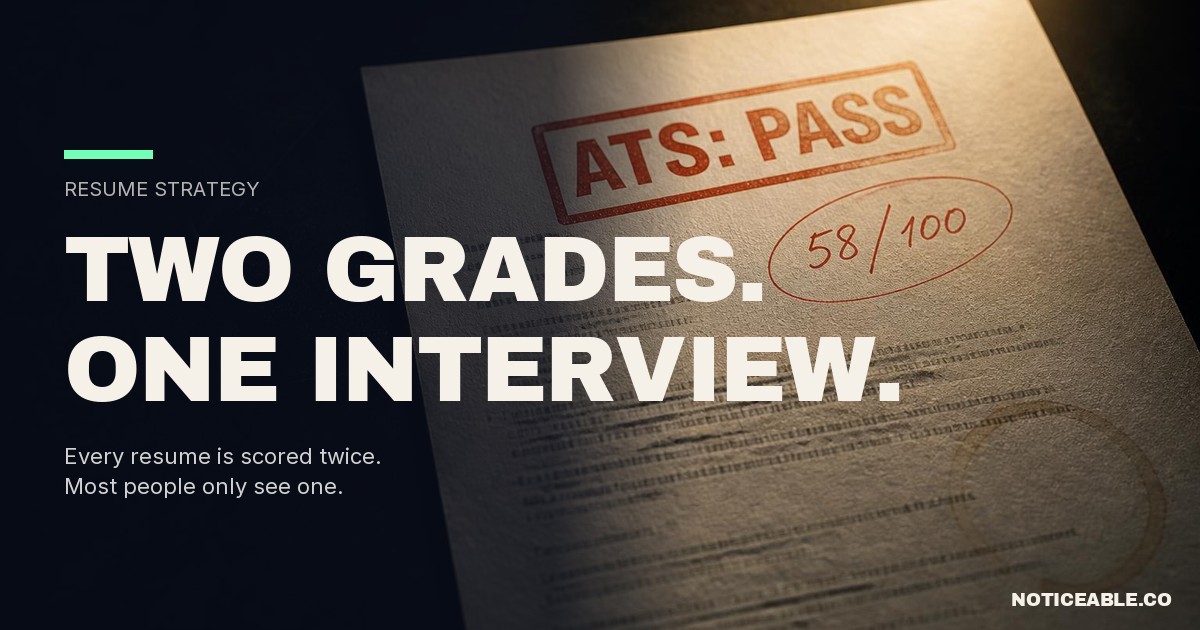
You've sent forty applications. Maybe eighty. Two callbacks, if that. The easy explanation is the market — too many candidates, too few openings, bad timing. The real explanation is usually smaller and more fixable: your resume has two grades, and you've never seen either one.
Every resume you send gets scored twice before a hiring manager forms an opinion about you. The first grade is silent, mechanical, and happens in under a second. That's your applicant tracking system score. The second grade is human, fast, and happens in about ten seconds. Miss the first and the second never happens at all. Pass the first and score low on the second, and the interview still doesn't come. Most job seekers know one of these grades exists. Almost none have seen either number.
Short version: the two scores are an ATS pass/fail against the exact job you applied to, and a human read score out of 100 for the first ten seconds a hiring manager gives your file. You can see both of yours free at benoticeable.co/resumeaudit.
Why it's rarely your experience
When silence piles up, the instinct is to question the qualifications. Not enough years. Wrong industry. Should've gone back for the certification. That instinct is almost always wrong, and it's an expensive one — it sends people back to school or into a confidence spiral over a problem that has nothing to do with what they've accomplished and everything to do with how it's been translated onto a page.
This is the question behind most of it: why am I not getting interviews when I'm qualified for the job? The resume that gets you interviews and the resume that gets you filtered out can describe the exact same career. The difference sits in two places: whether an applicant tracking system parses it correctly, and whether a hiring manager's first ten seconds land on proof instead of description. Both are fixable. Neither is visible to you by reading your own resume one more time.
If you've applied to 100 jobs with no response
The volume itself tells you something. One silent application is noise. Eighty is a pattern, and patterns come from the document, not from luck. Sending more of the same file into the same silence is the most common and most expensive move in a job search. Every cycle costs weeks and teaches you nothing, because nothing in the process ever tells you which of the two grades you failed.
The first grade: what the applicant tracking system decides before a human opens your resume
An applicant tracking system reads your resume before anyone on the hiring team does. It's parsing text, matching it against the job description, and deciding whether the file gets surfaced to a person at all. This isn't a vague "AI reads your resume" story — it's pattern matching against the specific language of the specific job you applied to.
What makes a resume fail ATS parsing
The failure modes are almost never about qualifications. They're structural. A two-column resume layout that scrambles the parsing order. Job titles and skills phrased close to the job description but not close enough to register as a match. Dates or section headers built as images instead of text. Achievements buried inside dense paragraphs instead of stated where the system expects to find them. A resume can represent a fully qualified candidate and still fail this grade, because the ATS isn't grading the candidate. It's grading the file.
This is the grade nobody explains, because nobody sees it happen. You don't get a rejection that says "failed parsing." You get silence, and silence gets misread as "not qualified" when the accurate read is "never seen."
How ATS scoring actually works: what the parser reads and what it ignores
Most applicant tracking systems work off the same core logic, even though the interfaces differ: they extract text from your file, break it into fields (contact info, job titles, dates, skills, education), then compare that extracted text against the specific job posting's language. The comparison isn't fuzzy in the way a human reading it would be generous. If the posting says "project management" and your resume says "managed cross-functional initiatives," a person understands those mean the same thing. A parser scoring on exact and near-exact matches often doesn't.
Why two resumes with identical experience score differently
Two resumes can represent identical experience and score completely differently. One happens to use the phrasing the target job is looking for. The other doesn't — not because the candidate is weaker, but because nobody ever showed them the gap between their language and the job's language. An ATS score isn't a verdict on your career. It's a measurement of how well your file speaks the specific dialect of the job you're applying to, and that's a solvable, mechanical problem once you can actually see it.
Which is also why a generic resume keyword checker can't answer the question you're asking. Scored against nothing in particular, a score means nothing in particular. The only ATS result worth acting on is a pass or fail against the exact job description you're chasing.
The second grade: the ten-second human read every hiring manager gives your resume
Clear the ATS, and the second test starts — a hiring manager with a stack of files and about ten seconds of attention before deciding whether to keep reading. This grade rewards a different thing entirely: not comprehensiveness, but proof. A resume that lists responsibilities reads like a job description. A resume that leads with outcomes — the number, the result, the thing that changed because you were there — reads like evidence.
Duties versus proof, in one line each
Most resumes fail this test quietly too. Not because the person didn't do the work, but because the resume describes the job instead of the impact. "Managed a team of six" is a duty. "Cut onboarding time from six weeks to nine days for a team of six" is proof. The hiring manager isn't grading your job history. They're grading whether you gave them a reason to keep reading past line four.
That's what a human read score measures: out of 100, on the first ten seconds, against the job in front of them.
The real cost of guessing which grade is failing
Here's the part that costs people the most time: without seeing either score, every fix is a guess. Rewrite the summary, tweak a font, swap a bullet, send it again, wait. That loop can run for months, because there's no signal telling you which grade is actually failing, or by how much — and each cycle costs another two to four weeks of silence before you even know whether the change helped.
From 58 to 82: what a resume audit before and after looks like
We ran this for one candidate recently — 58 out of 100 on the human read, failing the ATS check for the specific role she was chasing. Not a weak career. A resume that wasn't translating it. We rewrote it against the exact gaps the audit found, re-scored it, and watched the human read move from 58 to 82. Same experience, same person, two interview requests inside two weeks. Nothing about her background changed. The document finally matched what she'd actually done.
That's the difference between guessing and knowing. Guessing is rewriting blind and hoping the next version scores better than the last one felt. Knowing is seeing the number, seeing exactly what's dragging it down, and watching it move when the fix is real.
What a real resume audit shows you — and what generic resume feedback misses
A resume audit should answer three questions specifically, not generally: what's your human read score against this exact job, what's your ATS result for this exact job, and what's the gap list driving both numbers down. Generic advice — add more keywords, use stronger verbs — isn't an audit. It's a guess dressed up as guidance, because it isn't scored against anything real.
The four things a scored audit has to do
The version worth trusting does four things. It scores the human read out of 100. It scores the ATS as a pass or fail against the specific job description you're targeting, not an industry average. It lists the specific gaps behind both numbers — missing keywords, buried outcomes, structural issues, phrasing the ATS can't match. And it rewrites the resume against every gap it found and re-scores it, so the point movement is visible before anyone asks you to commit to anything.
That last part matters more than it sounds like it should. Most services ask for money before showing you anything has actually improved. A free resume audit that shows the before and after first removes the guess entirely. You're not trusting a promise. You're looking at two numbers.
Get your free resume audit: both scores in under 30 minutes
This isn't complicated to check. Upload your resume and the job description for the role you're actually chasing — two files, both PDFs — and get back your human read score, your ATS result for that specific job, the gap list behind both, and an automatic rewrite with the new scores. Under thirty minutes. Free. No credit card, no catch.
Most job seekers have sent dozens of applications into a silence they've misread as rejection. It's rarely rejection. It's usually two grades nobody ever showed them, failing quietly, for reasons that have nothing to do with whether they're good at the job.
See both of yours.
Get Noticed, Get Hired.
Frequently asked questions about ATS scores and resume audits
What's a good ATS score for a resume?
There's no universal passing number, because the score isn't measured against an industry average — it's measured against the specific job description you're applying to. The same resume can pass for one posting and fail for another depending on how closely the language matches. That's why a real audit scores against the exact job, not a generic benchmark.
Can a good resume still fail the ATS?
Yes, and it happens constantly. A resume can represent a fully qualified candidate and still fail on formatting — two-column layouts, text embedded in images, headers the parser can't read — or on phrasing that doesn't match the job posting closely enough. The ATS grades the file, not the person.
Why am I not getting interviews when I'm qualified for the job?
Because qualification and translation are two different things. Your resume can carry every year of experience the posting asks for and still fail the parse, or clear the parse and lose the ten-second human read by describing duties instead of proving impact. Until you see both scores, you can't tell which one is costing you the interview.
How is a human read score different from an ATS score?
The ATS decides whether a person ever sees your resume at all. The human read score measures what happens after that — whether a hiring manager's first ten seconds land on proof of impact or just a list of duties. You need to pass both, in that order, to get an interview.
Should I use a two-column resume template?
Not for anything you submit online. Two-column layouts read cleanly to a human eye and scramble the reading order for a parser, which can split job titles from dates and drop skills into the wrong field. Save the design-forward version for a portfolio or a direct email to a person.
Do all companies use an applicant tracking system?
Assume yes for anything you apply to through a company careers page or a job board. The file gets parsed before a person opens it. A small employer hiring through a referral or a direct email may read your resume first-hand. The safe default is to build one file that survives both.
Is a free resume checker accurate?
Depends entirely on what it scores against. A checker that grades your resume in isolation returns a number with nothing behind it. A checker that scores against the specific job description you uploaded is measuring something real, because that's the same comparison the employer's system makes.
What's the difference between a resume audit and a resume rewrite?
The audit tells you what's wrong and by how much: two scores plus the gap list behind them. The rewrite fixes it. The version worth using does both and re-scores afterward, so you see the point movement instead of taking the rewrite on faith.
How long does a resume audit take?
The version built into this process returns both scores, the gap list, and a rewritten version with new scores in under 30 minutes, at no cost.
Want this done for you?
A strategist rebuilds your resume against the posting you're chasing, within 24 hours.
Start my kit — $199.95